What Are Aspects in Astrology? A Beginner's Guide to Reading Planetary Conversations
Jul 17, 2026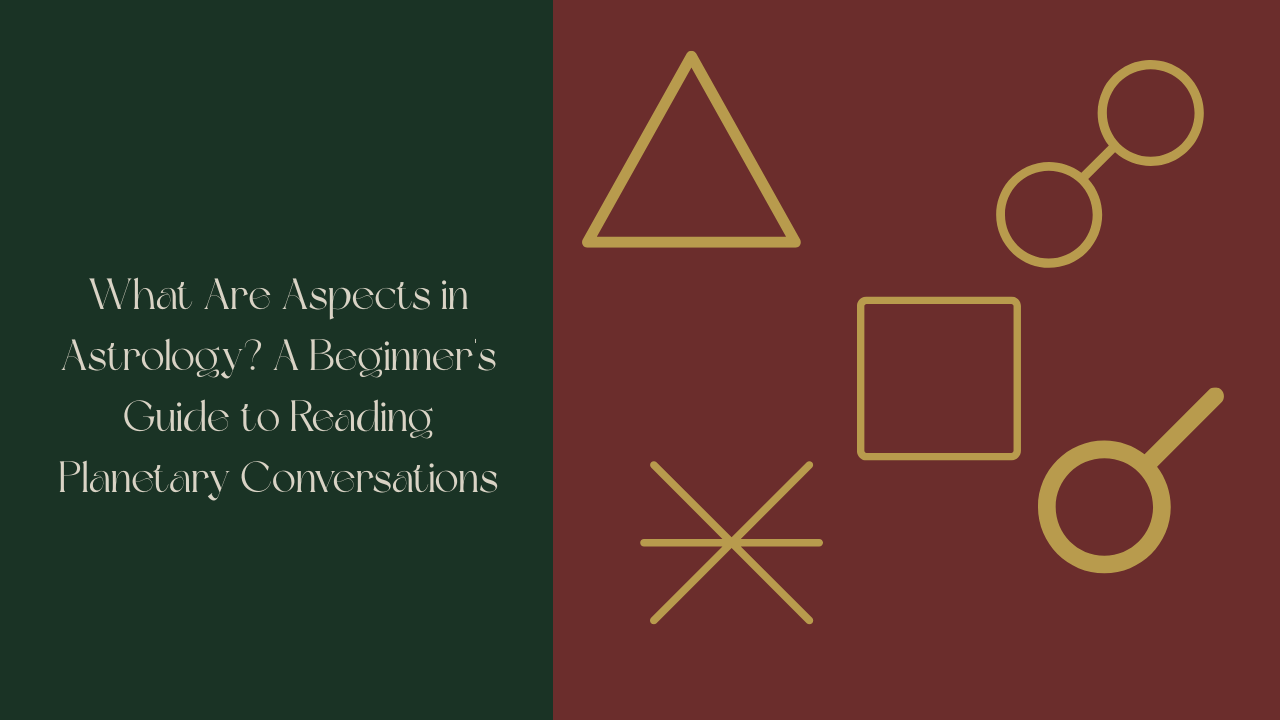
There comes a point in almost every astrology journey where you've learnt your Sun sign, discovered your Moon and Rising, perhaps even identified your chart ruler…
…and then you open your birth chart and wonder why someone has drawn what appears to be an elaborate game of celestial cat's cradle across the middle.
Red lines.
Blue lines.
Green lines.
Lines everywhere.
What are they actually telling you?
The answer is: quite a lot.
Those lines are called aspects, and they are one of the most important parts of a birth chart.
Without them, your chart is simply a collection of individual placements.
Aspects show you how those placements interact with one another.
In other words, if the planets are the characters in your story, the aspects reveal the conversations they're having.
What Are Aspects in Astrology?
An aspect is the geometric angle between two planets in your birth chart.
Each angle describes how those two planetary energies relate to one another.
Some flow naturally.
Some create friction.
Some encourage growth through challenge.
Rather than seeing planets as isolated pieces of information, aspects remind us that every part of your chart exists in relationship with something else.
Just as we all have different relationships with the people in our lives, your planets have different relationships with each other too.
Think of it like a group chat...
One of my favourite ways to think about aspects is to imagine all of your planets sitting around a kitchen table.
Mercury wants to analyse.
The Moon wants to feel.
Mars is already halfway through making a decision.
Saturn is quietly asking whether anyone has actually read the instructions.
Sometimes everyone agrees.
Sometimes two planets are talking over one another.
Sometimes one planet keeps bringing up a topic the others would rather avoid.
None of those conversations are good or bad.
They're simply different dynamics.
That's exactly what aspects describe.
The Five Major Aspects
| Aspect | Angle | Energy |
|---|---|---|
| Conjunction | 0° | Two planets join forces. |
| Sextile | 60° | Opportunity and cooperation. |
| Square | 90° | Friction that encourages growth. |
| Trine | 120° | Natural ease and flow. |
| Opposition | 180° | Two perspectives seeking balance. |
Conjunction (0°)
Imagine two colleagues sharing the same desk.
Sometimes they become an unstoppable team.
Sometimes they struggle to know where one person ends and the other begins.
A conjunction blends two planetary energies together.
For example, Mercury conjunct Venus often combines thoughtful communication with warmth, diplomacy and creativity.
The planets work as one voice.
Sextile (60°)
A sextile is often described as an opportunity.
The energies naturally support one another, but they still ask for your participation.
Think of it as someone holding a door open.
You still need to choose to walk through it.
Square (90°)
Squares have developed a rather unfair reputation.
Many astrology websites describe them as "difficult".
I don't particularly like that word.
Squares create tension, but tension isn't the same as misfortune.
Think about learning a new skill.
The challenge isn't comfortable.
But it's often where the greatest growth happens.
Squares ask:
"How might these two parts of me learn to work together?"
Trine (120°)
Trines feel natural.
The planets understand one another instinctively.
There's often an ease here that can feel like a genuine gift.
The only thing to watch?
Sometimes what comes easily is also what we take for granted.
Opposition (180°)
An opposition places two planets on opposite sides of the chart.
Rather than fighting, I like to imagine them sitting across the kitchen table from one another.
They see the world differently.
Neither is wrong.
The invitation is to listen to both perspectives instead of assuming one must win.
Are Some Aspects Good and Others Bad?
This is one of the biggest misconceptions in astrology.
No aspect is inherently good or bad.
A trine doesn't guarantee success.
A square doesn't guarantee struggle.
The way an aspect shows up depends on the whole birth chart and, perhaps even more importantly, your relationship with it.
The same square that once felt frustrating at twenty-five may become one of your greatest strengths by forty.
Astrology describes potential.
It doesn't remove your agency.
Why Aspects Matter
If you've read my previous articles, you'll know I often describe astrology as a language.
The planets tell us what.
The signs tell us how.
The houses tell us where.
The elements describe the quality of energy.
Aspects explain how all those parts communicate.
Without aspects, you're reading individual words.
With aspects, you're reading full sentences.
Reflection
The next time you look at your birth chart, try asking yourself:
Instead of wondering whether a placement is "good" or "bad"...
What conversation might these two planets be trying to have?
That small shift can completely transform the way you read astrology.
Final Thoughts
The beauty of aspects is that they remind us we aren't made up of isolated traits.
We're a collection of different needs, motivations and instincts, all learning how to live together.
Perhaps that's true of being human, too.
Some parts of us seek certainty.
Others long for adventure.
Some want to protect.
Others want to grow.
Astrology doesn't ask us to silence one voice in favour of another.
It invites us to listen to the whole conversation.
And when we do, we often discover that understanding ourselves isn't about finding the "perfect" placement.
It's about learning how all the different parts of us can work together.
If this idea resonates, you might enjoy reading Your Birth Chart Is a Conversation, Not a Conclusion, where we explore why astrology is less about finding definitive answers and more about learning to listen to yourself.
FAQ's
What is an aspect in astrology?
An aspect is the angle between two planets in your birth chart. It describes how those planetary energies interact and influence one another.
Which aspect is the strongest?
There isn't a single "strongest" aspect. Conjunctions, squares, trines, sextiles and oppositions each describe different types of relationships between planets.
Are squares always bad?
No. Squares often create tension, but they can also be powerful catalysts for growth, resilience and self-awareness.
Can I have no aspects in my birth chart?
Every birth chart contains aspects. The number and type vary from person to person, creating each chart's unique pattern of strengths, challenges and opportunities.
New to astrology? Here's a suggested reading order:
If you're ready to move beyond generic astrology and explore your birth chart as a practical tool for self-understanding, Living Abundantia was created for exactly that purpose.
Our digital guide, YOUR MOON SIGN: A Cosmic WORKBOOK to Self-Acceptance, translates your moon sign into clear, structured insights that help you better understand your strengths, how you may react during times of stress, overwhelm or overstimulation and your inner dialogue. All without the jargon or fatalistic predictions.
Stay connected meaningful updates!
Join our mailing list to receive the latest updates from our team.
Don't worry, your information will not be shared.
We hate SPAM. We will never sell your information, for any reason.