The Barbault Basket: Why Astrologers Are Watching July 2026 So Closely
Jul 20, 2026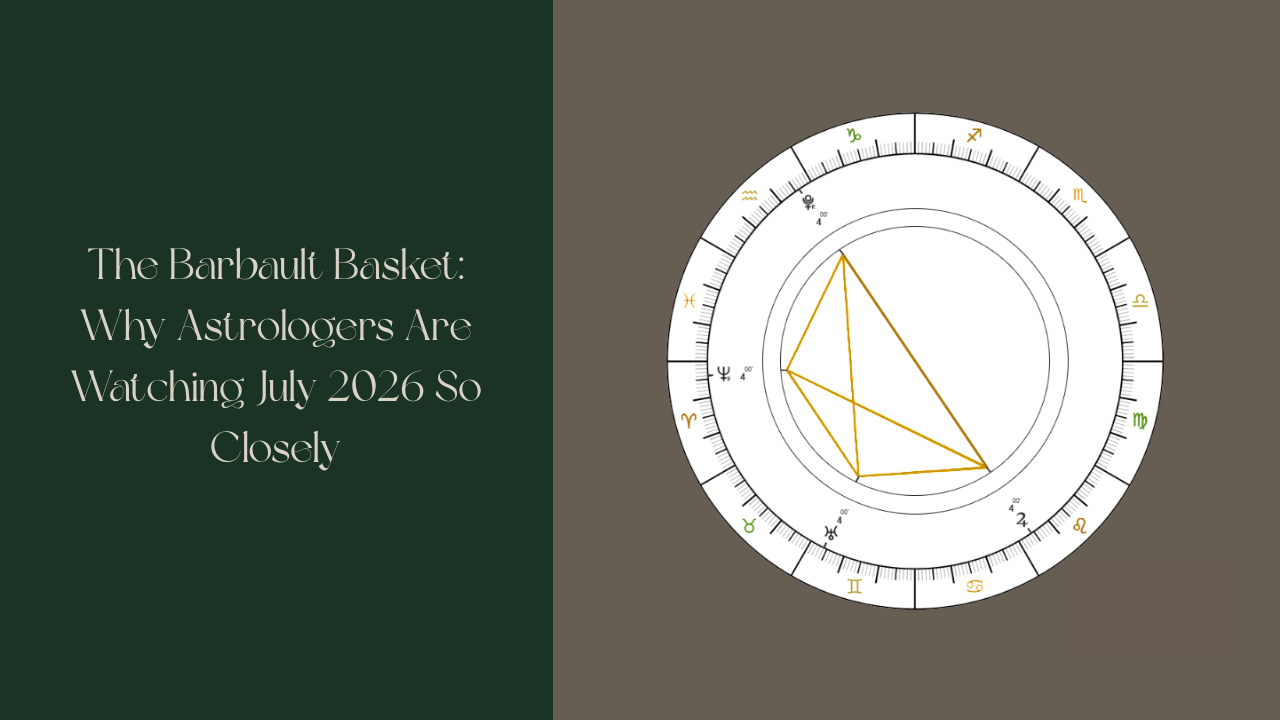
There are moments in astrology that arrive quietly.
A planet changes signs.
A New Moon invites fresh beginnings.
Mercury appears to retrace its steps.
And then there are moments that astrologers have been watching for decades.
July 2026 is one of them.
At the centre of the conversation is a rare planetary configuration known as the Barbault Basket.
Named after the French astrologer André Barbault, this remarkable alignment brings together four of the solar system's slowest-moving planets in an elegant geometric pattern, something that happens only rarely.
Whether you view astrology as symbolic, psychological, or something more, it's difficult not to pause when a configuration discussed for decades finally arrives.
This isn't an invitation to fear the future.
If anything, it's quite the opposite.
It's an opportunity to reflect on how much has already changed and what might be ready to grow next.
Who Was André Barbault?
Before we explore the astrology itself, it's worth understanding why André Barbault's work continues to be so respected.
Unlike many astrologers, Barbault dedicated much of his life to studying long-term planetary cycles rather than individual birth charts. His focus was mundane astrology, the branch of astrology that explores world events, collective movements, and historical trends.
For decades, he compared the movements of the outer planets with periods of war, political upheaval, economic shifts, and public health crises.
In a paper published years before 2020, Barbault highlighted that period as one likely to coincide with significant global disruption due to an exceptionally rare concentration of slow-moving planetary energy.
Following the COVID-19 pandemic, many astrologers revisited his research because of how closely the timing aligned with the cycle he had identified.
Barbault himself never lived to witness it.
He passed away on 7 October 2019, aged 98, just months before the first reported cases of COVID-19.
Whether you see that as remarkable foresight or an intriguing coincidence, his research continues to influence astrologers around the world.
What Is the Barbault Basket?
The Barbault Basket refers to a rare configuration involving four outer planets:
- Jupiter in Leo
- Pluto in Aquarius
- Uranus in Gemini
- Neptune in Aries
In July 2026, these planets form a balanced, cradle-like pattern across the zodiac.
Adding further significance, Jupiter and Pluto simultaneously form an exact opposition, creating dynamic tension within an otherwise supportive structure.
It's a configuration that combines two very different qualities.
On one hand, there is momentum, expansion, and bold vision.
On the other, there is transformation, questioning, and the dismantling of outdated systems.
It's less about choosing one over the other.
It's about learning how they can coexist.
Why Are Astrologers Paying Attention?
The outer planets move slowly.
Very slowly.
Neptune spends around fourteen years in one sign.
Pluto can remain in a sign for nearly two decades.
Because of this, their alignments often coincide with broad cultural shifts rather than isolated events.
Rather than describing individual experiences, they speak to the backdrop against which all of our lives unfold.
Many astrologers see July 2026 as representing a significant turning point within the longer story that began in 2020.
Not because every challenge suddenly disappears.
Life rarely works like that.
But because collective attention may begin shifting away from crisis management and towards rebuilding.
Towards asking:
"What do we want to create now?"
A New Chapter Rather Than a Clean Slate
It's tempting to think of turning points as neat endings.
As though one chapter closes and another begins without overlap.
Real life is rarely so tidy.
The experiences of the past six years have changed us.
Individually.
Collectively.
Professionally.
Emotionally.
Many of us reassessed our priorities.
Some changed careers.
Others relocated, ended relationships, started families, discovered slower ways of living, or realised success meant something entirely different than they once believed.
We don't leave those lessons behind.
We build upon them.
Perhaps that's what makes this moment feel quietly hopeful.
Not because it promises perfection.
But because it reminds us that rebuilding is possible.
The Wider Conversation in the Sky
Like every astrological moment, the Barbault Basket doesn't exist in isolation.
The sky is always alive with multiple conversations happening at once.
This rare alignment is taking place against a backdrop of innovation, experimentation, and changing social structures.
The emphasis feels less like returning to the old world and more like learning how to live in a new one.
There is curiosity here.
Creativity.
A willingness to question long-held assumptions.
Not every answer has arrived yet.
But the questions themselves are changing.
And that often marks the beginning of meaningful progress.
What Could This Mean Personally?
Collective astrology always filters through our individual birth charts.
Some people may notice this period more strongly than others.
If you have personal planets, your Ascendant, Midheaven, or other significant chart points close to 4° of Aries, Gemini, Leo, or Aquarius, this alignment may feel particularly meaningful.
Not because something is destined to happen.
But because these slow-moving planets are activating a deeply personal part of your chart.
You may find yourself reflecting on long-term direction, identity, purpose, or the ways you've changed since 2020.
If you're unsure where these signs fall in your chart, my guide on How to Read a Birth Chart for Beginners is a helpful place to start.
Questions to Reflect On
Rather than asking:
"What is going to happen?"
Try asking:
- Looking back to 2020, what part of my life has been transformed beyond recognition?
- What have I outgrown, even if I didn't realise it at the time?
- Which strengths have emerged through challenges I never would have chosen?
- What foundations feel strong enough to build upon over the next decade?
- If this really is the beginning of a new chapter, what do I want to carry forward—and what am I finally ready to leave behind?
If you have prominent placements near 4° Aries, Gemini, Leo, or Aquarius, you might also reflect on:
- Where am I being invited to think differently rather than simply do more?
- Which version of myself no longer fits?
- What future feels both exciting and slightly uncomfortable?
- Where might curiosity take me further than certainty ever could?
You don't need immediate answers.
Some questions are worth living with for a while.
Final Thoughts
One of the things I appreciate most about astrology is that it encourages us to zoom out.
When we're living through change, it can feel relentless.
When we look back, we often realise those same periods became defining chapters in our lives.
Whether history remembers the Barbault Basket as a major collective turning point remains to be seen.
But perhaps that's not the most important question.
Perhaps the more interesting question is this:
Who have you become since 2020?
Because whatever the sky is doing above us, that story is already unfolding within you.
And that feels like a conversation worth having.
FAQ's
What is the Barbault Basket?
The Barbault Basket is a rare configuration involving Jupiter, Uranus, Neptune, and Pluto. Named after French astrologer André Barbault, it is associated with major collective cycles and long-term societal change.
Why is July 2026 significant?
July 2026 brings these four slow-moving planets into a rare geometric relationship, with Jupiter and Pluto also forming an exact opposition. Many astrologers view it as an important turning point within a much larger historical cycle.
Did André Barbault predict COVID-19?
Barbault identified 2020 as a period likely to coincide with significant global upheaval based on long-term planetary cycles, years before the pandemic occurred. After COVID-19, many astrologers revisited his work because of the striking timing. While some describe this as a prediction, it's more accurate to say his research highlighted a period of exceptional collective change.
Will everyone experience the Barbault Basket in the same way?
No. Mundane astrology describes collective themes. Your personal experience depends on how these planetary movements interact with your individual birth chart.
If you're ready to move beyond generic astrology and explore your birth chart as a practical tool for self-understanding, Living Abundantia was created for exactly that purpose.
Our digital guide, YOUR MOON SIGN: A Cosmic WORKBOOK to Self-Acceptance, translates your moon sign into clear, structured insights that help you better understand your strengths, how you may react during times of stress, overwhelm or overstimulation and your inner dialogue. All without the jargon or fatalistic predictions.
Stay connected meaningful updates!
Join our mailing list to receive the latest updates from our team.
Don't worry, your information will not be shared.
We hate SPAM. We will never sell your information, for any reason.